
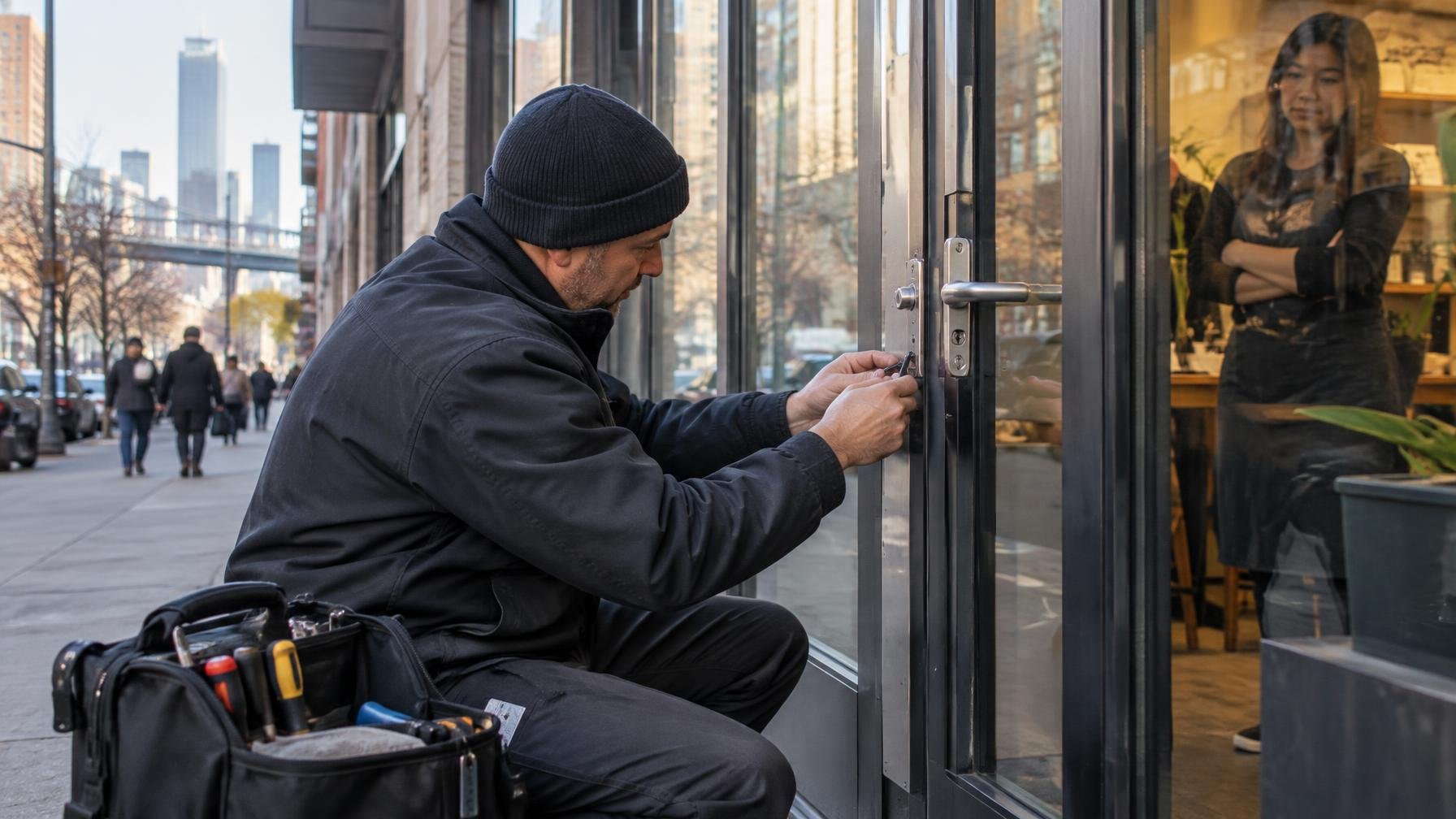
If you need a commercial locksmith in Downtown Brooklyn, the first step is identifying whether you have an access problem, damaged hardware or keys that should no longer work. LEO Locksmith provides 24/7 mobile service for business lockouts, commercial lock repairs, rekeying and security upgrades, with the technician quoting the price on site before work starts. Whether your business occupies a Fulton Street storefront or an office near Borough Hall, the right solution depends on the door, the building’s rules and who needs access.
Start With the Door and the Immediate Risk
“The lock isn’t working” can describe several different problems. A key that will not turn, a handle that moves without retracting the latch and a door that refuses to close securely need different checks. Tell dispatch what happens when you use the door rather than trying to diagnose the internal mechanism yourself.
- Locked out, but the door appears intact: Check whether an authorized manager, superintendent or employee has a working spare.
- The door opens but will not secure: Keep the entrance supervised while arranging help. Do not assume turning the key means the latch has engaged.
- A key is bent or partly broken: Stop using it. Forcing it can leave a fragment inside the cylinder.
- There are signs of forced entry: Do not enter if someone may still be inside. Contact emergency services if there is an immediate threat, and follow police guidance before disturbing damaged hardware.
Do not chain an occupied business’s exit shut or add an improvised lock that prevents people from leaving. Security work should preserve safe exit operation, not solve one problem by creating another.
Downtown Brooklyn Buildings Need Different Lock Solutions
A street-level shop near the Fulton Mall does not have the same access needs as an office suite above a shared lobby on Court Street. Before requesting work, identify exactly which door is involved and whether your business controls it.
Street-Level Storefronts
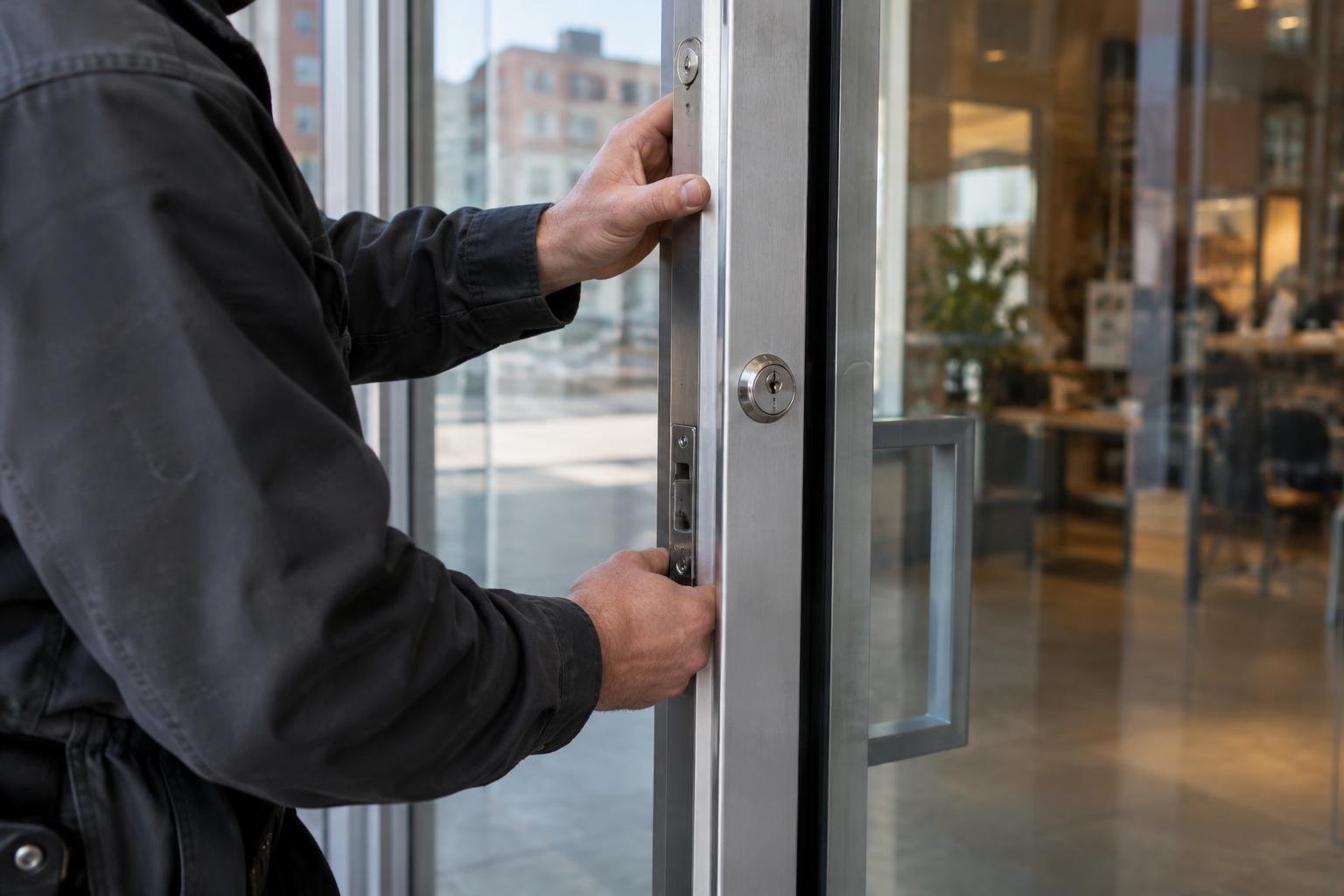
Glass storefront doors often use narrow-stile hardware that differs from a standard residential deadbolt. Heavy daily use can expose loose components, a worn cylinder or a latch that no longer lines up with its receiving opening. On paired doors, the inactive leaf also needs to stay properly secured for the active door to lock reliably.
If your entrance includes a rolling gate, describe the gate lock separately from the glass door lock. One may be operating normally while the other prevents opening or closing. LEO’s storefront locksmith service addresses storefront hardware and gate locks, so explaining both helps establish the scope of the visit.
Office Suites and Shared Buildings
In a multi-tenant building, the lobby credential, elevator access and suite key may be three separate systems. A locksmith working on your suite does not automatically have authorization to modify the shared entrance. Contact building management first when the problem involves common areas, building-issued credentials or a lock connected to a master key system.
Downtown Brooklyn also has businesses in older mixed-use properties. Existing door preparations and mortise hardware can limit replacement choices. A lock that looks similar online may not fit the door or perform the same functions.
Repair, Rekey or Replace: Which Fits Your Problem?
Replacing everything is not always necessary. The useful distinction is whether the problem concerns the physical operation of the lock, control of existing keys or the suitability of the hardware.
Repair When the Lock or Door Is Not Operating Correctly
A loose handle, sticking latch or deadbolt that needs pressure on the door may call for door lock repair. If the key turns smoothly with the door open but binds when it is closed, alignment may be contributing to the problem. That observation is useful for the technician, but it does not identify every possible cause.
Do not keep slamming the door or using the key as a handle. Mention whether the issue started suddenly, gradually worsened or changes during wet or cold weather. The technician can assess whether the lock is repairable or whether another door condition needs attention.
Rekey When Old Keys Should Stop Working
Rekeying changes the lock’s internal key configuration so the previous keys no longer operate it. It can make sense after employee turnover, a lost key or taking over a commercial space, provided the existing hardware is compatible and in suitable condition.
List every affected door before the visit: front entrance, rear entrance, stockroom and private office, for example. If only one cylinder is rekeyed, an old key may still open other doors. Also disclose any master key arrangement so the technician can account for authorized management access.
Replace When Hardware Is Damaged or No Longer Suitable
Replacement may be appropriate after forced entry, when parts are worn beyond practical repair or when the existing lock does not meet the business’s operational needs. A new lock still needs to fit the door and work correctly with its latch, strike and exit hardware.
Discuss the actual goal: preventing former staff access, improving key control or making daily opening and closing more reliable. These are different problems, and a hardware upgrade alone may not address all of them.
What to Prepare Before the Technician Arrives
A little information helps avoid confusion, particularly when the business entrance differs from the building’s main address. Around Jay Street, Flatbush Avenue Extension and busy retail blocks, clearly identifying the correct entrance is more useful than simply naming the nearest intersection.
- Exact location: Provide the street address, business name, floor, suite and entrance instructions.
- Door description: Say whether it is glass, metal or wood, and whether it has a keypad, lever, deadbolt or push bar.
- Access status: Explain whether anyone is inside and whether an authorized alternate entrance is available.
- Authorization: Have identification and information showing that you can authorize work, such as management confirmation or business occupancy documentation.
- Building coordination: Check whether the superintendent, security desk or property manager needs to be present.
Tell dispatch about loading restrictions or check-in procedures, but do not promise a parking space you do not control. LEO Locksmith is based in Hollis, Queens, and serves all five boroughs through mobile service. Ask live dispatch for a current arrival estimate; traffic, technician location and building access can affect timing.
When Access Control Makes More Sense Than More Keys
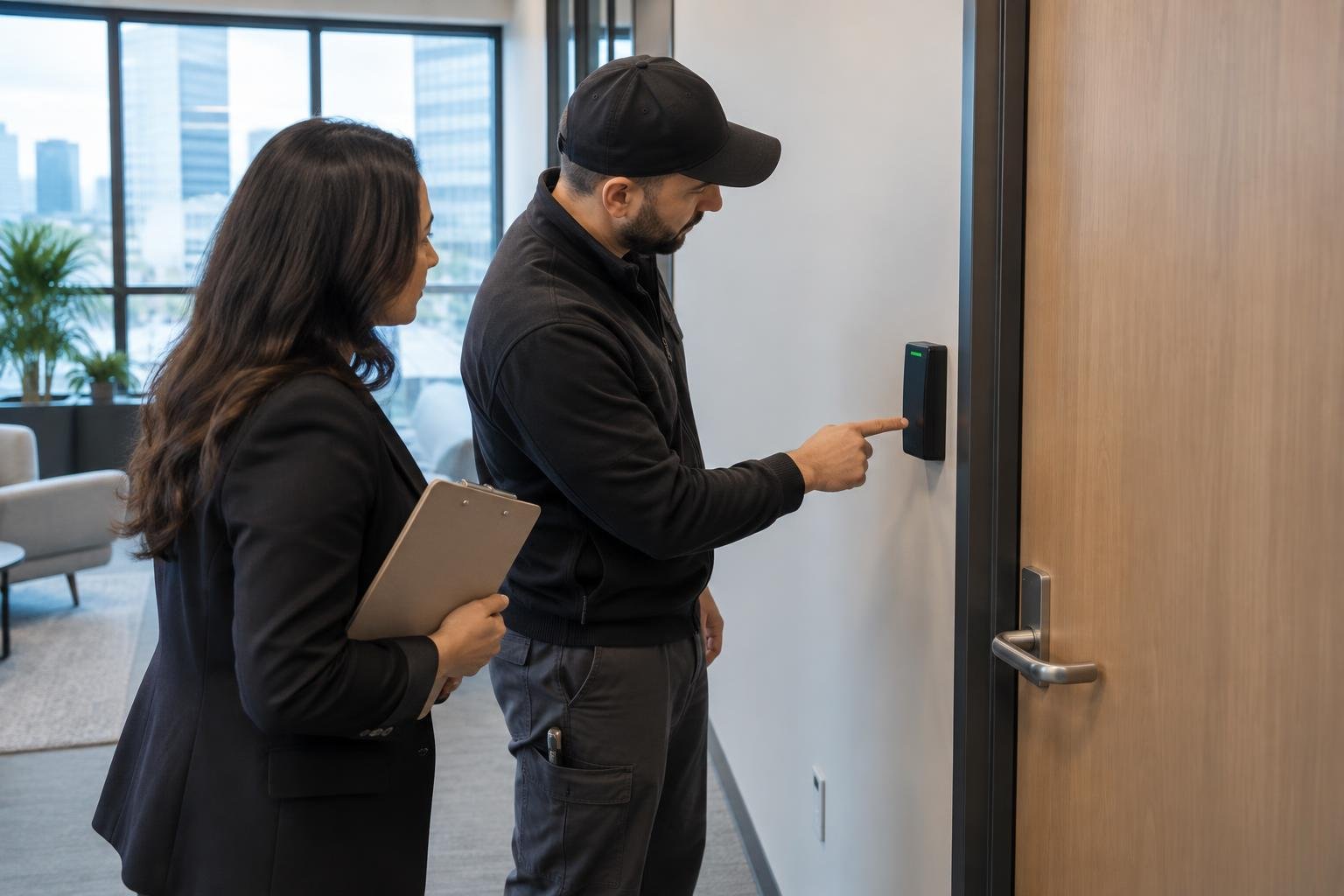
If staff regularly join, leave or change schedules, issuing additional metal keys may make access harder to manage. A properly selected access control system can allow individual credentials to be removed without collecting every physical key. Suitability depends on the door, existing hardware and the building’s requirements.
Before choosing keypads, fobs or mobile credentials, answer these questions:
- Who needs access before opening and after closing?
- Should office staff, stockroom staff and vendors have different permissions?
- Who will add and remove credentials when staffing changes?
- What should happen during a power or network interruption?
- Does the entrance need to coordinate with building-managed access?
A shared keypad code is convenient, but it becomes difficult to control if employees pass it along. Individual credentials may offer clearer accountability where the selected system supports it. Review backup access, credential management and exit operation before installation—not after someone is locked out.
What to Expect During Commercial Locksmith Service
The technician should first confirm the affected door, your authorization and what you want the repair or upgrade to accomplish. For a lockout, LEO Locksmith prioritizes non-destructive entry when possible. The available method depends on the lock, its condition and the circumstances; an undamaged opening cannot be promised for every door.
The technician quotes the price on site before any work starts. Clarify which doors and components the proposed work covers, including whether you are approving repair, rekeying or replacement. If the assessment changes the proposed approach, ask for an explanation before authorizing additional work.
Before the visit ends, test the door through a complete cycle: open it, close it normally, lock it and unlock it. Check operation from both sides where appropriate, including the exit hardware. For rekeying, confirm the new keys operate the intended cylinders and ask how remaining authorized keys are affected.
Call a Commercial Locksmith in Downtown Brooklyn
A business lock problem should end with reliable access and a door that secures properly—not a workaround your staff must remember every shift. LEO Locksmith provides 24/7 mobile help across Brooklyn and the other four NYC boroughs for commercial lockouts, repairs, rekeying, storefront locks and access control.
Have your address, door details and authorization information ready. For help with your Downtown Brooklyn business, Call LEO Locksmith at 929-764-7097.
Frequently Asked Questions
Can a commercial locksmith rekey my Downtown Brooklyn business after an employee leaves?
Yes, compatible locks in suitable condition can often be rekeyed so previous keys no longer work. Identify every door the employee could access and disclose any building master key system before authorizing changes.
Can LEO Locksmith help with a glass storefront door lock?
Yes. LEO Locksmith services storefront locks, including hardware used on glass doors. Describe whether the key will not turn, the latch will not retract or the door will not secure so the technician can assess the right components.
Do I need building management approval for office lock work?
Check your lease and building procedures before modifying hardware. Shared entrances, building-issued credentials and master-keyed locks generally require coordination with management. Be ready to show that you are authorized to request the work.
Will a business lockout require drilling the lock?
Not necessarily. LEO Locksmith prioritizes non-destructive entry when possible, but the method depends on the hardware, its condition and the situation. The technician can explain the proposed approach after assessing the door.
How is the price for commercial locksmith work determined?
The technician quotes the price on site before any work starts. Explain which doors are affected and clarify whether the proposed work includes entry, repair, rekeying or replacement before approving it.
Is commercial locksmith service available after business hours?
LEO Locksmith offers 24/7 mobile service in Downtown Brooklyn and across all five NYC boroughs. Call 929-764-7097 and ask live dispatch for a current arrival estimate; timing depends on traffic, technician location and building access.